

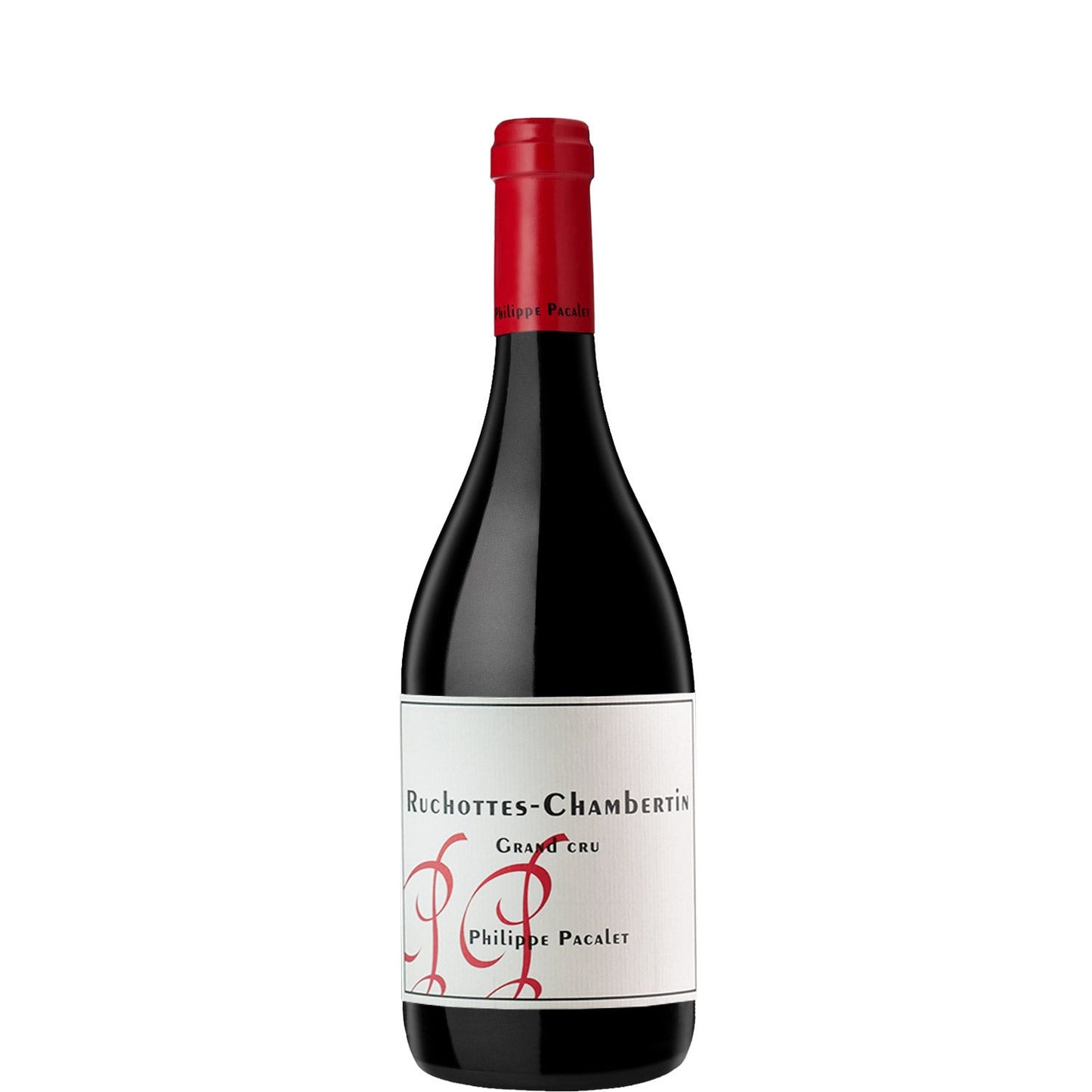
Ruchottes-Chambertin Grand Cru, Philippe Pacalet, 2024
Ruchottes-Chambertin Grand Cru, Philippe Pacalet, 2024
- 75cl
- 13%
- Red Still
- Pinot Noir
- Organic
- Biodynamic
Couldn't load pickup availability

Optimal drinking window: 2032 - 2050
Ruchottes-Chambertin is the smallest of the Gevrey grands crus and, in the hands of Philippe Pacalet, arguably the most arresting. Pacalet works the vines without herbicides or synthetic treatments, vinifies with whole clusters, and bottles with minimal sulphur — the result is Pinot Noir of extraordinary translucency. Ruchottes sits at the top of the Gevrey slope, hard against the limestone escarpment, and that altitude and exposure give it a cooler, more austere character than its neighbours: more Chambolle in its delicacy, more Gevrey in its iron grip.
"Deep raspberry fruit with a regal feel. Velvet tannins and intense raspberry compote. Pure and authoritative."
Nathan Hill, Chairman
Philippe was clear that while yields were historically low, the payoff is in the glass. Aromatic clarity, saline finishes and finely judged tannins run through the range, and the wines show real charm already alongside the structure to age. A year where selection mattered enormously, and in Pacalet’s hands, the results are compelling.
Philippe Pacalet is one of Tim Atkin's 2024 Top 15 Négociants & Cooperatives.
What the critics say:
"Coming from the top of the cru, this showcases black cherries, sweet plums, evergreen and excellent tang. The rather weighty (for the vintage), sweeping palate delivers unexpected generosity nicely encased by sculpted tannins. Don’t rush—this easily deserves seven to eight years of cellar time."
"There is a marvellously expressive blackberry fruit, with notes of violets, spice and a slightly exotic, savoury, gamey edge. This is an impressively concentrated wine, tannic and firm, not only a triumph particularly for the vintage but for any year. The grapes were fermented as whole bunches and the wine is ageing in barrels, mostly used. This should open in five years and will easily drink for 20 more and beyond."
Ruchottes-Chambertin sits at the very top of the Gevrey-Chambertin grand cru slope, at around 300 metres, directly beneath the limestone cliff. The soils are exceptionally thin — just a few centimetres of brown limestone-rich earth over hard Bathonian limestone bedrock — which forces the vines deep, limits yields naturally, and produces wines of striking mineral tension. The higher altitude and easterly exposure mean cooler temperatures than the lower grands crus, which translates into later ripening, greater acidity, and a more restrained, chiselled style than Chambertin itself.
Ruchottes-Chambertin is one of nine grands crus in Gevrey-Chambertin and, at just 3.3 hectares, one of the tiniest in all of Burgundy. Only Pinot Noir is permitted, and the appellation sits immediately above Mazis-Chambertin on the upper slope. Where Chambertin and Clos de Bèze tend toward power and opulence, Ruchottes is defined by austerity and mineral intensity — less immediately seductive, but with a haunting precision that rewards long cellaring. Production is tiny and allocations fiercely contested; it rarely appears on the open market.
The 2024 growing season in Burgundy was, frankly, a test of nerve. A wet spring brought significant mildew pressure, and vignerons who stayed sharp in the vineyard — working fast, keeping canopies open, reducing yields where necessary — came out the other side with something worth talking about. Summer brought warmer, drier conditions that helped the fruit recover composure, and harvest arrived broadly on the later side, with growers picking carefully to find phenolic ripeness without sacrificing freshness. Quantity was down across much of the Côte, which concentrates minds as much as it concentrates wine.
What emerged is a vintage that rewards those who put the work in. The Pinots we have tasted carry real precision and translucency — not because they are light, but because the acidity is lively and the fruit unforced. Chardonnays from the Côte de Beaune look particularly promising: taut, mineral, with genuine length. This is not a vintage to panic-open. Most village and premier cru reds want three to five years at minimum, with the better appellations drinking well until 2035 and beyond. The whites are more approachable now, though the best will reward patience too.

Explore related wines


-
-
Speak to one of our Wine Gurus
Speak to a Wine GuruWith years of experience, our team can help you with all your wine buying and selling needs