

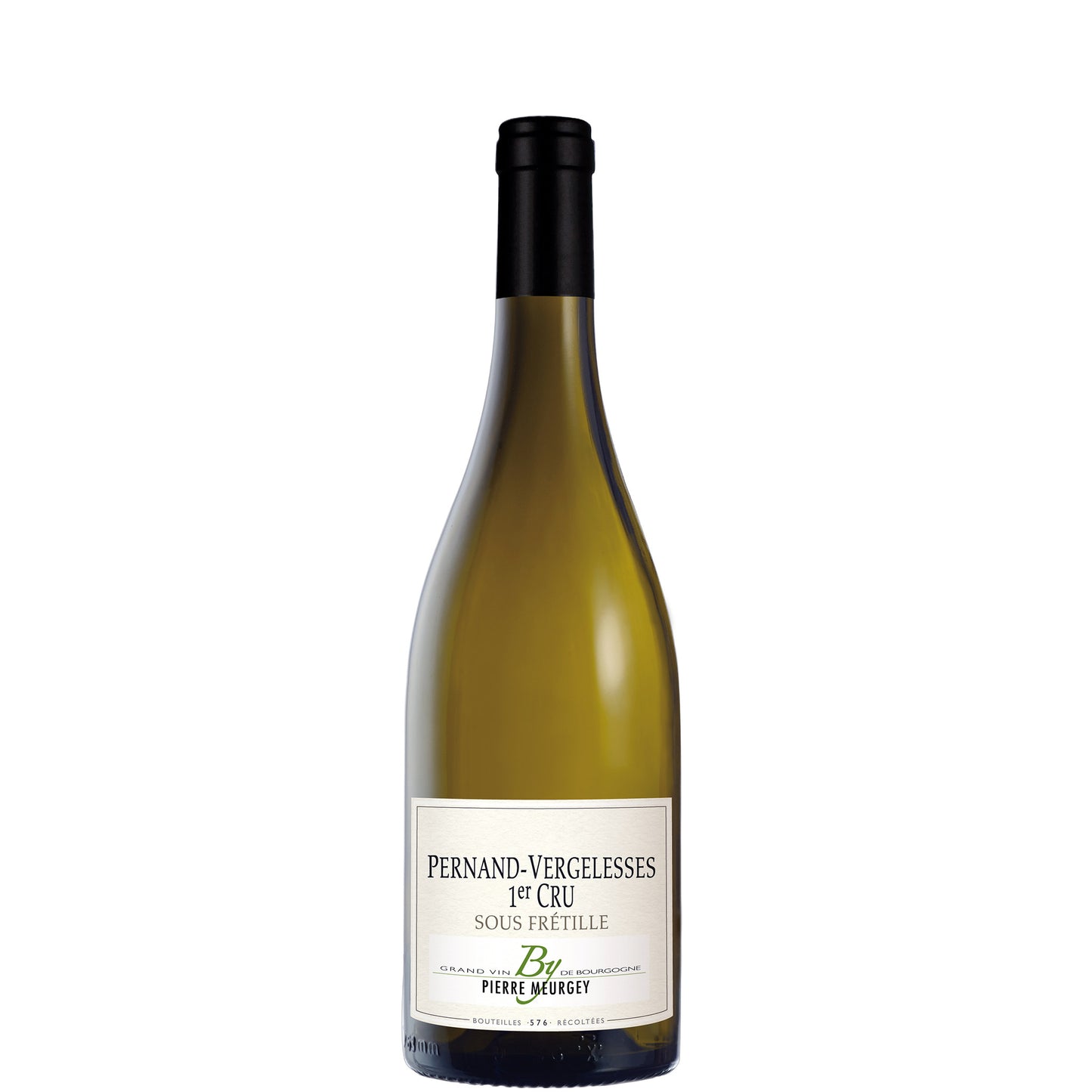
Pernand-Vergelesses Premier Cru 'Sous Frétille', Pierre Meurgey, 2019
Pernand-Vergelesses Premier Cru 'Sous Frétille', Pierre Meurgey, 2019
- 75cl
- 13%
- White Still
- Chardonnay
Couldn't load pickup availability

Optimal drinking window: 2026 - 2034
Pernand-Vergelesses is one of those Burgundy villages that rewards those who bother to look past the famous names on the hill above it. Sous Frétille is a premier cru that sits on the Corton hill itself, sharing geology with its grand cru neighbours but priced as though nobody has noticed. Pierre Meurgey, a respected figure in the Burgundy négociant world with deep roots in the region, brings a sure hand to this wine: it has the tension and grip you'd want from a serious white Burgundy without tipping into austerity.
The 2019 vintage gave Burgundy wines with generous, sun-ripened fruit balanced by freshness, and this is no exception. White peach, lemon curd, and a streak of chalky minerality run through the palate, with oak well-integrated and very much playing a supporting role.
Right now, in 2026, the 2019 is at an enjoyable but slightly transitional stage: the primary fruit is still vivid and the oak influence is integrating, but the wine hasn't yet settled into its full secondary complexity. Give it another two to three years and you'll start to see the characteristic Pernand shift — the fruit becoming more nutty and honeyed, the minerality more pronounced and complex. By 2029 to 2031, this should be at its most complete, with the tension and richness in proper balance. After 2034, the acidity may begin to relax and the wine could start to lose its definition, so it's best enjoyed while that stony precision is still intact.
What the critics say:
"Here the expressive nose is compositionally similar to the straight Pernand, but it offers better layering. On the palate the medium weight flavors possess more volume and richness while displaying a highly refreshing salinity on the markedly more complex and persistent finale. This is really quite good and worth checking out and is a wine that should also drink reasonably well early while rewarding a few more years of cellaring. *Outstanding* *Top Value*"
Tasting Notes
AppearancePale gold with a faint green rim, clear and bright.
NoseRestrained and focused, with white peach, lemon zest, and a light, toasty hazelnut character from well-judged oak. There's a distinctly stony, almost chalky quality underneath that gives the whole thing a sense of place.
PalateTaut and precise on entry, with medium-full body and good natural acidity keeping everything lively. The fruit is generous for the appellation — ripe citrus and stone fruit — but it never strays into heaviness, with the limestone-inflected grip pulling it back into line.
FinishLong and saline, with a fine, mineral persistence that lingers well after the fruit has faded.
Overall impressionA serious, structured white Burgundy that has the architecture to age but enough generosity to drink well now.
Food Pairings
In the villages around the Côte de Beaune, a wine like this would land on the table alongside poulet de Bresse in a cream and morel sauce — the classic local pairing that has defined Burgundian hospitality for generations. Quenelles de brochet with a beurre blanc is another natural companion, the richness of the fish mousse meeting its match in the wine's acidity and minerality. Closer to home in Pernand, locals might simply serve it with a terrine of pike or a plate of Époisses on the younger side, before the cheese gets too pungent. This is also a natural partner for roast veal or a simple gratin dauphinois — dishes where butter and cream play a leading role.
We think this wine would go well with
Serve at 12-13°C — cold enough to keep the freshness, warm enough to let the texture open up. No need to decant, though giving it fifteen minutes in the glass before drinking will do no harm as the wine opens. A wider-bowled white Burgundy glass, rather than a narrow tulip, will give the wine the room it needs to show its character.
Sous Frétille sits on the eastern flank of the Corton hill, where the soils are a mix of white Bathonian limestone, marl, and a little clay — the same bedrock that underpins the grand cru vineyards directly above. The altitude and aspect give good natural ventilation, which helps preserve acidity even in warmer vintages. This combination of calcareous soils and elevation is what gives the wines of Pernand their characteristic stony edge and relatively lean frame compared to the richer whites of Meursault or Puligny.
Pernand-Vergelesses is a small AOC village appellation tucked behind the Corton hill at the northern end of the Côte de Beaune. It is one of the few communes to produce both red and white premier cru wines, with the premiers crus — including Sous Frétille, Île des Vergelesses, and En Caradeux — sharing the hill with the Corton and Corton-Charlemagne grands crus. Whites here tend to be leaner and more mineral than those of Meursault, with a stony, almost austere quality in youth that softens beautifully with a few years of age. The appellation remains significantly undervalued relative to its famous neighbours, which makes it one of the Côte de Beaune's better-kept secrets.
The 2019 vintage in Burgundy delivered exactly what vignerons needed after a string of challenging years: a textbook growing season that let the grapes ripen slowly and evenly. Spring arrived gently, summer stayed warm without punishing heat spikes, and crucially, September brought those cool nights that preserve acidity whilst allowing full phenolic ripeness. We find ourselves talking about 2019 as one of those vintages where nature simply cooperated, giving winemakers healthy fruit with natural balance rather than forcing them to correct for extremes in the cellar.
What emerged are Burgundies with remarkable freshness married to genuine depth—the Pinot Noirs show that silky texture and bright red fruit character that makes great Burgundy so compelling, whilst the Chardonnays have both the mineral backbone and subtle richness that age beautifully. The quality runs impressively deep across all appellations, from village wines that drink like premier crus to grand crus that remind you why Burgundy commands such devotion. These wines are drinking beautifully now if you fancy them young and vibrant, though we suspect the better bottles will reward patience well into the 2030s.
FAQs
What does this wine taste like?
Precise and mineral-driven, with white peach, lemon, and toasted hazelnut from well-integrated oak. The defining characteristic is a chalky, stony quality that runs through the palate and lingers on the finish — this is a white Burgundy defined by tension rather than weight.
When should I drink this wine?
It's drinking well now but is still in the early stages of its development. If you hold on until 2028 or 2029, you'll be rewarded with greater complexity and a more settled integration of all its parts. We'd drink it until 2034.
What food should I pair with this wine?
Classic Burgundian fare works best: roast chicken with cream and morel sauce, veal, pike quenelles, or a gratin dauphinois. The wine's acidity and minerality also make it a natural match for richer fish dishes like turbot or sole meunière.
Is this a good introduction to white Burgundy?
It's a great one, actually. Pernand-Vergelesses sits in the shadow of Corton-Charlemagne and is considerably more affordable, but the wines share the same stony hill and a similar structural character. If you want to understand what makes the Côte de Beaune's whites so distinctive, this is an excellent and honest place to start.
How should I serve this wine?
Serve it at around 12-13°C in a wider white Burgundy glass. No need to decant, but let it breathe in the glass for ten to fifteen minutes before drinking. Avoid serving it too cold, as it will close up and hide much of its character.
Is Sous Frétille a well-known premier cru?
Not as well-known as it deserves to be. Sous Frétille sits on the Corton hill, sharing its geology with some of Burgundy's most celebrated grand cru vineyards, yet Pernand-Vergelesses as a whole tends to fly under the radar compared to Meursault, Puligny, and Chassagne. That relative obscurity is very much the buyer's gain.
Explore related wines


What are you looking for tonight? Tell me the occasion, a grape, a region — or just try a suggestion below.
Your recommendations will appear here.
-
-
Speak to one of our Wine Gurus
Speak to a Wine GuruWith years of experience, our team can help you with all your wine buying and selling needs