
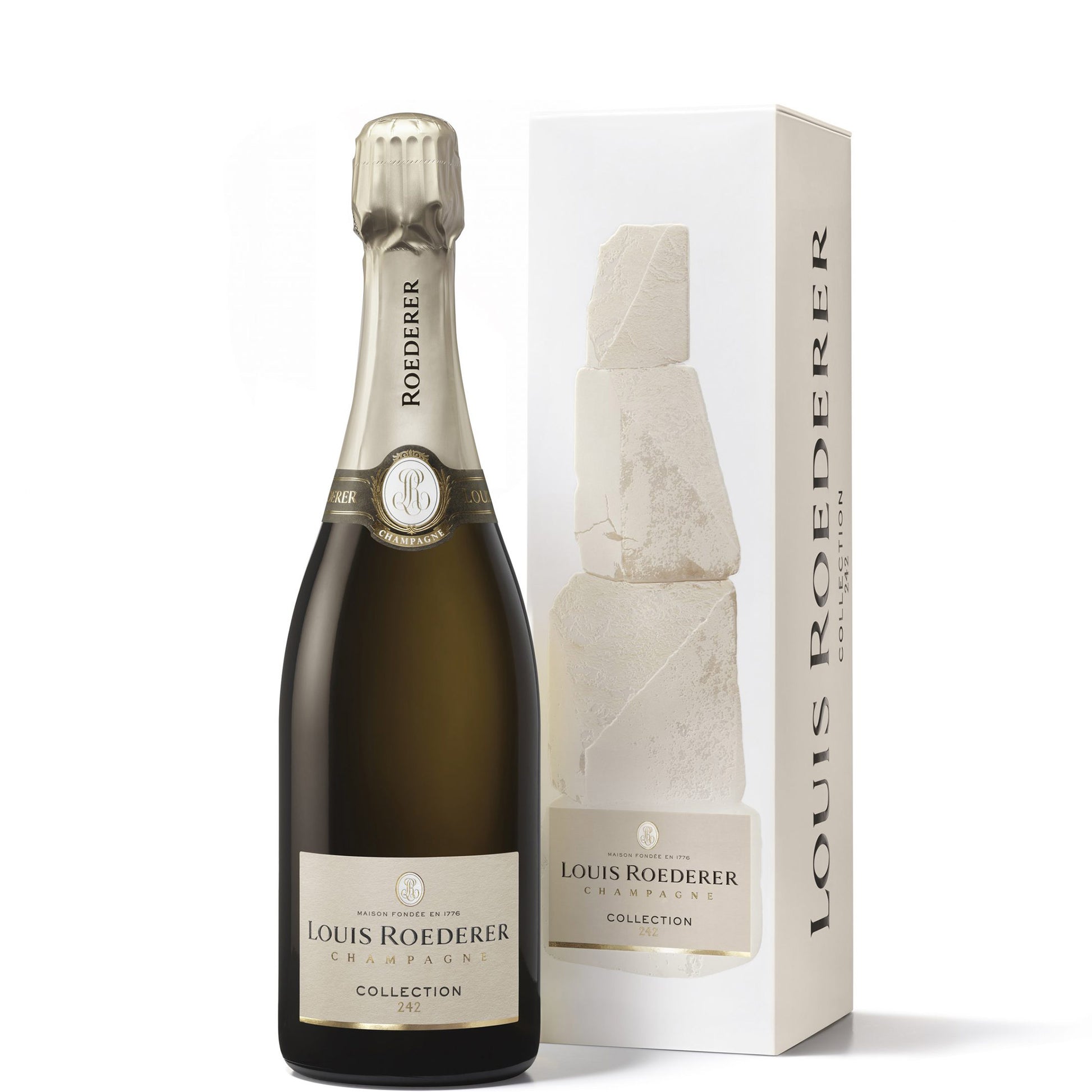
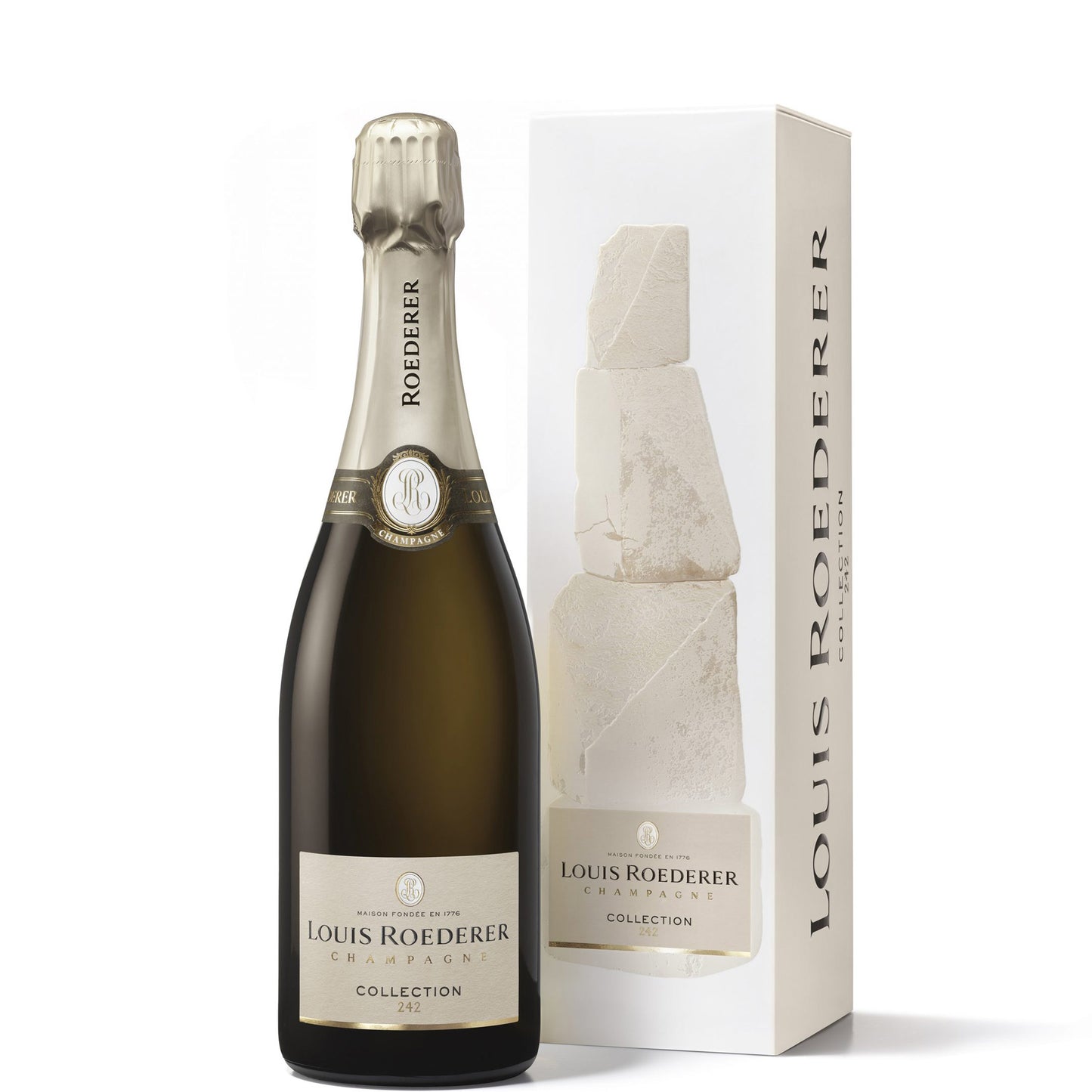
Louis Roederer, Collection 242, Multiple Vintages
Louis Roederer, Collection 242, Multiple Vintages
- 75cl
- 12%
- White Sparkling
- Chardonnay, Pinot Meunier, Pinot Noir
- Organic
- Biodynamic
Couldn't load pickup availability

Optimal drinking window: Now - 2035
Designed to represent the new approach the house is taking in line with the importance they place on sustainability and efforts to reduce the effects of climate change, the Louis Roederer Collection identifies and brings out the characteristics of terroirs enjoying sustainable practices.
Over half the grapes in this MV are from the 2017 vintage, a year when no Vintage Louis Roederer, Cristal or Cristal Rosé will not be released. The best of the crop has found its way into this particular cuvée. Collection 242 signifies the 242nd harvest since its foundation in 1776 and replaces the Brut Premier NV.
Collection 242 is drinking well now and has been since release — the four years on lees and the complexity of the blended reserve wines mean there is already real depth in the glass. Over the next two to three years, the primary apple and citrus fruit will begin to integrate further with the nuttier, more oxidative notes from the perpetual reserve, nudging the wine toward something richer and more autumnal. By around 2028 to 2029, it should be at its most complete. Beyond that, the freshness that defines its character will start to soften, and while it will not fall apart, the tension that makes it exciting will gradually ease. We would not hold it past 2030.
What the critics say:
"Aromas of cooked apple, bread dough and lemon tart follow through to a full body with round, delicious fruit and a rich, flavorful finish. Yet, it remains tight and fine with lovely, compressed bubbles. New energy and freshness. Medium-to full-bodied with layers of fruit and vivid intensity. 42% chardonnay, 36% pinot noir and 22% pinot meunier. 8 grams dosage. Four years on the less. A new-format non-vintage that designates the year of the 242nd harvest, 2017, plus reserve wine of 2009, 2011, 2013, 2014, 2015 and 2016. Drink or hold."
"The NV Collection 242 is a new wine from Roederer that replaces the Brut Premier in the range. The Collection (which now will be numbered by harvest) is a blend of three components: a perpetual reserve done in the classic non-malo Roederer style, reserve wines in oak with a touch of malo, and a base vintage, in this case 2017. That blend results in a NV Champagne that offers lovely richness and resonance, with plenty of yellow orchard fruit and floral character. Whereas Brut Premier was typically a focused, nervy wine that, while consistently excellent, also was not always in line with the Roederer house style, the 242 tastes more like a Roederer Champagne in terms of its complexity. Incidentally, there is no Vintage, Cristal or Cristal Rosé in 2017, so all the best lots went into this bottling. Dosage is 8 grams per liter, so lower than the 9 or so that was typical for recent Brut Premier and much lower than the 12-13 that was once customary. The 242 was also bottled with a bit less sugar than the norm, which results in lower atmospheres of pressure in the bottle and silkier texture."
"The palate has encyclopedic depth, the intricacies of the Perpetual Reserve weaving their early magic; almond, sloe, gingerbread and apples; the finish has a pleasing twist of bitterness, courtesy of the small percentage of oak-aged reserve wine."
Tasting Notes
AppearancePale gold with a fine, persistent bead and a soft luminosity that hints at time on the lees.
NoseCooked apple and lemon tart up front, with bread dough and a gentle nuttiness from the reserve wines. There is a deeper layer beneath — sloe, gingerbread, and a faint waft of almond that belongs entirely to Roederer's perpetual reserve.
PalateFuller than you might expect from a non-vintage Champagne, with round yellow orchard fruit and a richness that comes directly from the 2017 base vintage having nowhere else to go — no Cristal, no Vintage, just this. The silky texture is a function of slightly lower pressure in the bottle, the dosage trimmed to 8 grams, and four years on the lees doing their quiet work.
FinishLong, with a pleasing twist of bitterness at the end — the oak-aged reserve wine making its presence known without overstating the case.
Overall impressionMore Roederer than any non-vintage from this house has felt in years, and that is very much the point.
Food Pairings
In the Marne, this style of Champagne would be opened without ceremony alongside a platter of andouillette or a slice of jambon en croûte, the richness of the wine cutting straight through the fat. Oysters from the Normandy coast are a near-perfect match, their salinity amplifying the wine's mineral edge. A pot of rillettes with cornichons and a good baguette is the kind of honest, satisfying pairing the French do without thinking. If you want to go further, a roast guinea fowl or a simple poulet rôti with tarragon butter would suit the wine's weight and depth rather well.
We think this wine would go well with
Serve at 8 to 10 degrees Celsius — cold enough to keep the bubbles lively, warm enough to let the complexity of the reserve wines show. No need to decant, though ten minutes in the glass before you start drinking it properly will open it up considerably. A tulip-shaped Champagne glass rather than a flute gives the nose more room to breathe and does better justice to the wine's texture.
Roederer's vineyards span the three great zones of Champagne: the Montagne de Reims for Pinot Noir, the Vallée de la Marne for Pinot Meunier, and the Côte des Blancs for Chardonnay. The house has been converting substantial portions of its estate to organic and biodynamic farming since the early 2000s, believing that healthy, living soils produce more expressive fruit than conventionally farmed land. The chalk subsoil that underlies most of the Champagne region provides both the natural drainage and the mineral tension that is the backbone of every wine in the range. Collection 242 draws on this breadth of sites, blending across zones and vintages to build complexity that no single vineyard or year could deliver alone.
Champagne is the most tightly regulated sparkling wine appellation in the world, confined to a small region northeast of Paris where chalk soils and a marginal climate conspire to produce grapes of unusually high natural acidity. Only three grape varieties are permitted in the blend: Chardonnay, Pinot Noir, and Pinot Meunier. Non-vintage Champagne, the style into which Collection 242 falls, must spend a minimum of fifteen months on the lees before disgorgement, though the best producers far exceed this. The appellation permits the blending of reserve wines from multiple years, which is precisely what gives non-vintage Champagne its house-style consistency across harvests.
FAQs
What does Collection 242 taste like?
Richer and more complex than the Brut Premier it replaced. Cooked apple, lemon tart, and bread dough on the nose, with a fuller palate built around yellow orchard fruit, almond, and a hint of gingerbread from the older reserve wines. The finish has a satisfying bitter twist. It is not a delicate, nervy Champagne — it has real weight and presence.
Why is it called Collection 242?
The number refers to Roederer's 242nd harvest since the house was founded in 1776, which in this case was 2017. Going forward, each new release will be numbered by harvest year, replacing the old Brut Premier NV format with something that gives more information about what is actually in the bottle.
When should I drink it?
It is ready now and will continue to drink well until around 2029 or 2030. The reserve wines in the blend give it enough complexity to reward a year or two more in the cellar, but there is no need to wait — this is not a wine that needs to be coaxed open.
What makes this different from the old Brut Premier?
Quite a lot, actually. The 242 uses a new blending approach that incorporates a perpetual reserve (wines kept and refreshed over multiple years), oak-aged reserves, and a clearly identified base vintage. The dosage has been reduced to 8 grams per litre, the pressure in the bottle is slightly lower for a silkier texture, and the result tastes far more like a Roederer wine than the Brut Premier often did. Critics and the house itself have been fairly candid about this.
What food works well with it?
Oysters are the obvious answer, but this wine has enough body to go further. Roast guinea fowl, jambon en croûte, rillettes with cornichons, or a simple roast chicken with tarragon butter all work well. The richness of the wine and the bitter finish mean it can handle a fair amount of fat on the plate.
Is it worth cellaring?
A couple of years will do it good, taking it to a slightly more complex, nuttier stage where the perpetual reserve makes itself more clearly felt. Much beyond 2029 and the freshness that defines it will start to fade. If you have several bottles, drink the first now and the rest over the next three years.
OUR GROWERS
Louis Roederer
Explore related wines


What are you looking for tonight? Tell me the occasion, a grape, a region — or just try a suggestion below.
Your recommendations will appear here.
-
-
Speak to one of our Wine Gurus
Speak to a Wine GuruWith years of experience, our team can help you with all your wine buying and selling needs