

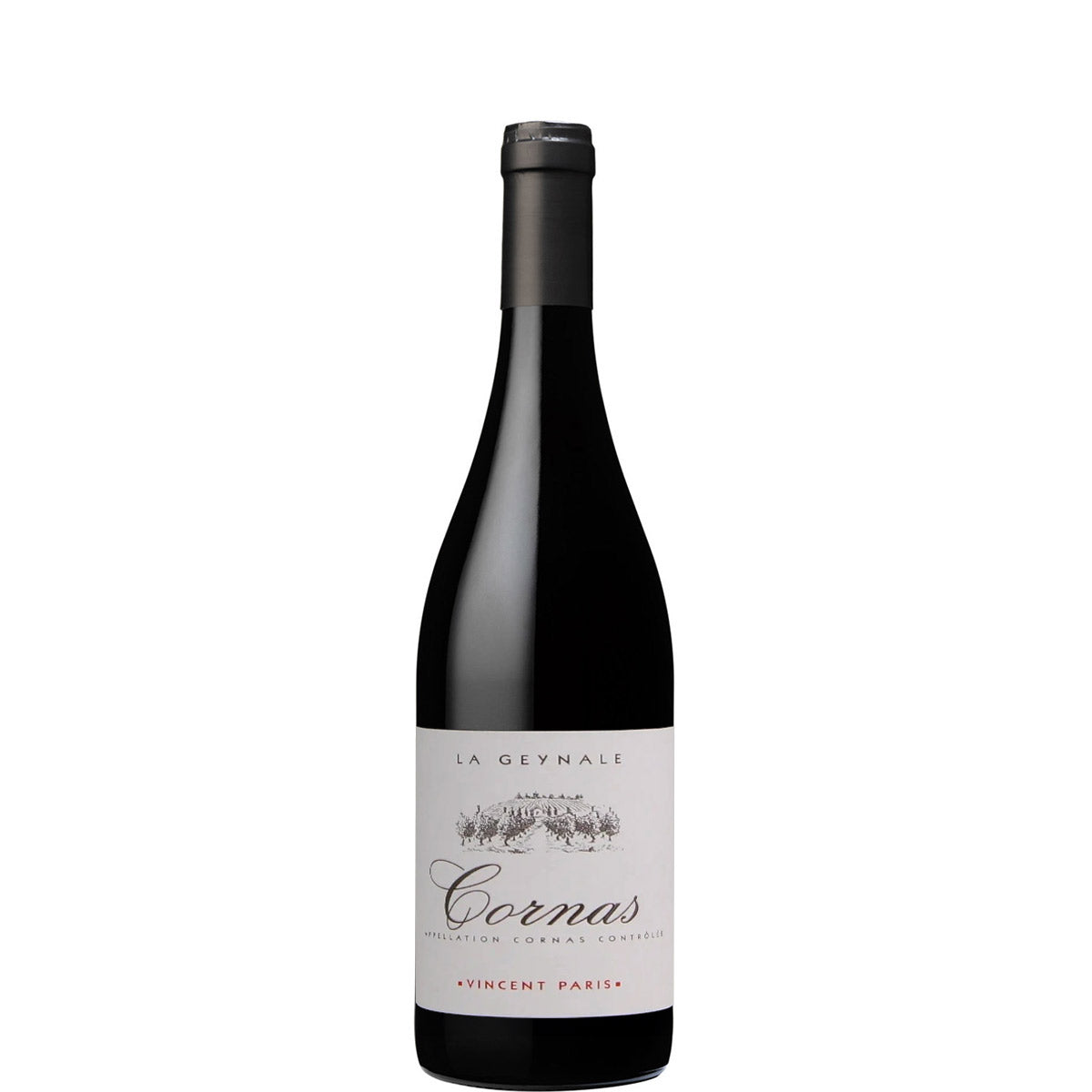
Domaine Vincent Paris, Cornas 'La Geynale', 2021
Domaine Vincent Paris, Cornas 'La Geynale', 2021
- 75cl
- 14%
- Red Still
- Syrah
Couldn't load pickup availability

Optimal drinking window: 2026 - 2040
The Domaine Vincent Paris Cornas ‘La Geynale’ 2021 is a striking, powerful expression of Cornas. In the glass, it’s almost opaque, with aromas of blackberries, cassis, cracked pepper, and warm spice unfolding into hints of smoked meat and earth. The palate is dense and richly layered - waves of dark fruit, graphite, and spice balanced by an almost electric minerality. The tannins are firm yet silky, giving structure without heaviness, and the finish seems to go on forever. A wine of power and precision.
La Geynale comes from Vincent’s oldest vines, over 100 years old, planted on the steep, south-facing slopes of the Reynard district, one of Cornas’s most revered terroirs. The wine spends a year in used oak barrels (none new) to preserve purity.
Vincent Paris farms just eight hectares in Cornas and Saint-Joseph, working meticulously to keep yields low and quality high. His thoughtful approach in both vineyard and cellar has made him one of the Rhône’s most admired winemakers.
Right now, La Geynale 2021 is in its early, tightly wound phase — the fruit is vivid but the structure is dominant, and patience will be rewarded. By 2027 the tannins should start to integrate properly, and the wine's secondary complexity — iron, dried herbs, cured meat — will begin to emerge alongside the dark fruit. The mid-2030s look like a likely peak window, where the wine's precision and depth should be fully realised. Given the century-old vines and the granite backbone, there is no reason to expect it to fade before 2038 to 2040. Drink it before then and you are, in a sense, arriving early to the party.
What the critics say:
"Expressive nose of blackberries, cassis, black pepper, smoke and sweet spices. Medium body with finely grained tannins and fresh acidity. Impressive volume on the mid-palate with a grainy texture. Balanced with a restrained power. It’s concentrated and well-rounded. Long and focused finish with peppery notes. A reference for the appellation in this fresher vintage. Best after 2025."
"A gorgeous nose, fresh, precise and surprisingly aromatic for a Cornas. The smoky oak and peppery Syrah spice combine well. Not massive, this is actually quite lean and precise, but there’s a great sense of energy and focus. The tannins are intense, quite sharp and bony, but should round out in time. The acidity is really quite intense, this will always be a brisk, athletic Cornas, but should make some complex old bones. Fairly long finish. Whole-bunch fermented from 100-year-old vines grown in Reynard. Aged in used barrels, no new oak. "
Tasting Notes
AppearanceAlmost opaque deep violet, with just a thin rim of translucency at the edge.
NoseDark, coiled, and surprisingly aromatic for Cornas — ripe blackberry and cassis giving way to cracked pepper, smoked meat, and a shimmer of violet. The peppery Syrah spice is vivid and precise, without any sense of heaviness or extraction.
PalateLean and athletic rather than massive, with waves of dark fruit underpinned by graphite and a raw, mineral tension that runs like a current through the wine. The tannins are firm and bony — very much there — but they have shape and direction rather than blunt force, and the acidity keeps everything taut and alive.
FinishLong and focused, ending on a clean pulse of pepper and stone rather than fruit.
Overall impressionA brisk, precise, serious Cornas from a fresher vintage — built for the long game, and honest about it.
Food Pairings
In the Ardèche, this kind of wine traditionally sits alongside slow-braised lamb with herbs and black olives — the region's cooking is robust, unapologetically rustic, and built around long cooking times that echo the wine's own patience. A daube of wild boar, or roasted duck with a sauce of dark cherries and juniper, would match the wine's depth without competing with it. Aged Cantal or Saint-Nectaire, both produced not far north in the Massif Central, would work well if you're in a cheese mood — their earthy, slightly funky character suits the wine's smokier registers. Keep the food dark, savoury, and unhurried.
We think this wine would go well with
Serve at around 17°C — any warmer and the alcohol starts to dominate the wine's more elegant qualities. Decanting is strongly recommended: give it at least 90 minutes, ideally two hours, to open up and allow the tannins to soften just enough to let the fruit through. A large-bowled Burgundy-style glass will give the wine the room it needs to express its aromatic range.
La Geynale is sourced from Vincent's oldest parcels in the Reynard lieu-dit, one of Cornas's most prized sites, where century-old Syrah vines cling to steep, south-facing granite slopes. The thin, sandy decomposed granite soils force the vines to dig deep, concentrating flavour and building the electric mineral backbone the wine is known for. The south-facing aspect maximises sun exposure at this northerly latitude, while altitude and the valley's channelled winds temper the heat and preserve freshness. It is a site that rewards old vines above almost everything else.
Cornas is a small, entirely red-wine appellation on the west bank of the Rhône, just south of Saint-Joseph, producing Syrah and nothing else. It has historically been the rough, brooding sibling to the more celebrated Hermitage — darker, chewier, less immediately welcoming — though a generation of careful growers has reframed it as a site of genuine precision and age-worthiness. The appellation covers around 150 hectares of steep granite hillside, with no sub-appellations or classifications, meaning individual growers and their vineyard choices do most of the talking.
The 2021 Rhône had drama written all over it from the start. Spring frost knocked back yields across the valley, followed by a wet summer that kept growers on edge about disease pressure. When September finally arrived with warm, dry weather, those who'd managed their vineyards carefully through the challenging months found themselves with concentrated, healthy fruit that ripened beautifully in the sunshine.
What emerged defied the difficult growing season: wines with real energy and freshness, particularly impressive in the Northern Rhône where Syrah shows lovely spice and pepper alongside its dark fruit. The Southern Rhône produced Châteauneuf-du-Papes and Côtes du Rhônes with more restraint than the blockbuster years, but we rather like that - there's a liveliness here that makes them brilliant with food. The reds are drinking well now and will continue to develop until 2030 or beyond for the best cuvées, while the whites - often overlooked but particularly successful this year - are singing right now.
FAQs
What does La Geynale taste like?
Think dark, coiled, and precise rather than plush or generous. Ripe blackberry and cassis lead, with cracked pepper, smoked meat, graphite, and a raw mineral tension running underneath. It is an athletic, focused Cornas — not a blockbuster.
When should I drink this wine?
It is approachable now with a long decant, but it is not at its best yet. We would suggest waiting until 2027 or 2028 The bones are excellent and it should drink well until 2040.
Is it worth cellaring?
Absolutely, and arguably it is the main point. The century-old vines and granite soils have given the 2021 a structural framework that genuinely needs time. If you have the patience, put it away and revisit in five to eight years.
What food should I serve it with?
Slow-braised lamb, wild boar daube, duck with dark fruit sauces, or aged Cantal cheese. You want food that is dark, savoury, and slow-cooked — this wine does not suit anything light or delicate.
How should I serve it?
At around 17°C with a generous decant of at least 90 minutes to two hours. Use a large-bowled glass to give the aromas room. Do not rush it.
How does this compare to other Cornas wines?
La Geynale is widely considered one of the appellation's reference wines. The 2021 is fresher and more precise than some warmer vintages, which makes it more linear and less obviously powerful — but that is part of its appeal. It sits comfortably alongside Clape and Allemand as a benchmark for what old-vine Cornas can do.

OUR GROWERS
Domaine Vincent Paris


What are you looking for tonight? Tell me the occasion, a grape, a region — or just try a suggestion below.
Your recommendations will appear here.
-
-
Speak to one of our Wine Gurus
Speak to a Wine GuruWith years of experience, our team can help you with all your wine buying and selling needs