

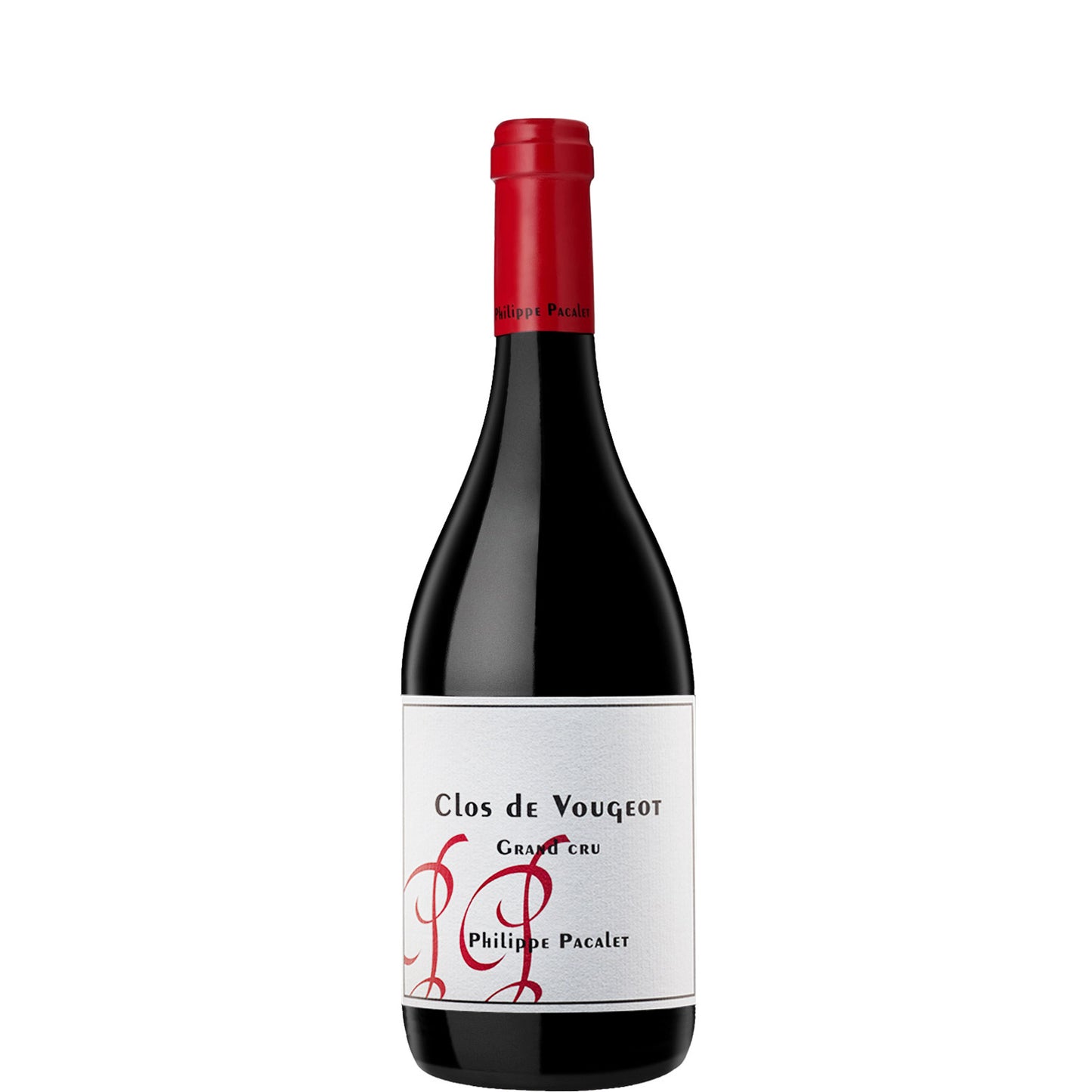
Clos de Vougeot Grand Cru, Philippe Pacalet, 2024
Clos de Vougeot Grand Cru, Philippe Pacalet, 2024
- 75cl
- 13%
- Red Still
- Pinot Noir
- Organic
- Biodynamic
Couldn't load pickup availability

Optimal drinking window: 2030 - 2045
Clos de Vougeot is Burgundy's great democratic paradox: a single 50-hectare Grand Cru walled by Cistercian monks in the 12th century, now carved between roughly 80 different owners. What you get depends entirely on who made it. Philippe Pacalet's version is about as far from the overripe, oak-heavy interpretations that gave this cru a complicated reputation as it's possible to get. Philippe has spent his career making wines of crystalline precision from purchased fruit, using minimal sulphur and indigenous yeasts. The result here is a Clos de Vougeot that feels more like a Chambolle than a Vosne — all nervous energy and lifted red fruit rather than brooding weight.
"1.5 barrels – parcel near Vosne-Romanée. Deep purple and black fruit. Spicy, rich and intense with dense, slightly sweet dark fruit and impressive length."
Nathan Hill, Chairman
Philippe was clear that while yields were historically low, the payoff is in the glass. Aromatic clarity, saline finishes and finely judged tannins run through the range, and the wines show real charm already alongside the structure to age. A year where selection mattered enormously, and in Pacalet’s hands, the results are compelling.
Philippe Pacalet is one of Tim Atkin's 2024 Top 15 Négociants & Cooperatives.
What the critics say:
"This is a chewy, muscular Clos de Vougeot with attractively rugged tannins and refreshing flair. Racy acidity brightens the dark-fruited finish tinged with amaro-esque bitterness. Sophisticated and savory, this will benefit from additional bottle aging–at least four to five years. This was aged entirely in older barrels. The Pacalets have 4.5 rows that run from bottom (clay-rich) to top (loaded with seashells) on the southern end of the clos."
Clos de Vougeot sits on the mid-slope of the Côte de Nuits between Chambolle-Musigny and Vosne-Romanée, and the variation in soil across its 50 hectares is considerable. The upper sections, closest to the treeline, sit on thin limestone soils over rock and produce the most structured, mineral wines; the lower parcels near the RN74 have deeper, richer clay and tend toward fleshier results. Pacalet's fruit is understood to come from the upper and mid-slope, where the drainage is better and the cooler influence of altitude gives the wine its characteristic lift and definition. The enclosing stone wall, the clos itself, helps moderate temperature and protect the vines from wind.
Clos de Vougeot is a single Grand Cru AOC in the Côte de Nuits, unique in Burgundy for its sheer size relative to its quality tier — 50.6 hectares in one block, yet divided among dozens of owners, which creates extraordinary variation in style and quality. It sits between Musigny to the north and the Vosne-Romanée Premiers Crus to the south, and at its best combines the floral lift of Chambolle with the structure and depth of Vosne. Only Pinot Noir is permitted, and yields are restricted, though the disparity between growers means it is one appellation where the producer's name matters as much as the label. Its reputation has historically been uneven, but producers like Pacalet have done much to restore its standing.
The 2024 growing season in Burgundy was, frankly, a test of nerve. A wet spring brought significant mildew pressure, and vignerons who stayed sharp in the vineyard — working fast, keeping canopies open, reducing yields where necessary — came out the other side with something worth talking about. Summer brought warmer, drier conditions that helped the fruit recover composure, and harvest arrived broadly on the later side, with growers picking carefully to find phenolic ripeness without sacrificing freshness. Quantity was down across much of the Côte, which concentrates minds as much as it concentrates wine.
What emerged is a vintage that rewards those who put the work in. The Pinots we have tasted carry real precision and translucency — not because they are light, but because the acidity is lively and the fruit unforced. Chardonnays from the Côte de Beaune look particularly promising: taut, mineral, with genuine length. This is not a vintage to panic-open. Most village and premier cru reds want three to five years at minimum, with the better appellations drinking well until 2035 and beyond. The whites are more approachable now, though the best will reward patience too.

Explore related wines


-
-
Speak to one of our Wine Gurus
Speak to a Wine GuruWith years of experience, our team can help you with all your wine buying and selling needs