

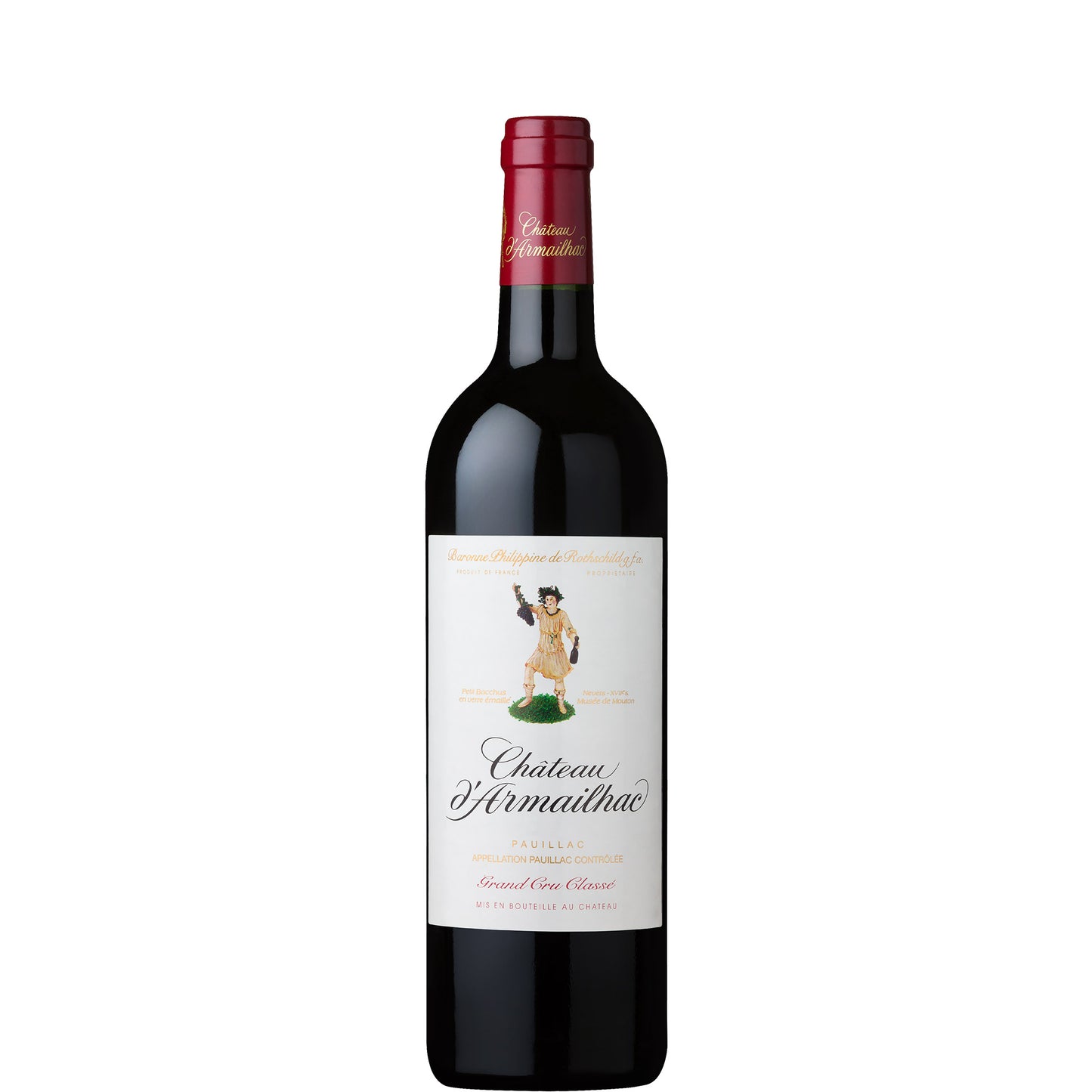
Château d'Armailhac, 2017
Château d'Armailhac, 2017
- 75cl
- 13.5%
- Red Still
- Cabernet Sauvignon, Merlot, Cabernet Franc, Petit Verdot
Couldn't load pickup availability

Optimal drinking window: Now - 2040
A historic estate in Pauillac, Château d’Armailhac creates wines of elegance and finesse, reflecting the estate's illustrious past and prestigious terroir.
The 2017 vintage in Bordeaux was challenging due to weather conditions, but the wines from top estates like Château d'Armailhac still show good structure, balance, and aging potential.
Cases of 12 are presented in original wooden cases.
Currently showing primary blackcurrant fruit with tight tannins that need time to integrate - patience will transform this wine completely. By 2030, the muscular structure will soften and secondary cedar and tobacco notes will begin emerging alongside the core fruit. The peak drinking window arrives around 2035 when tertiary complexity of leather and forest floor will add layers whilst maintaining freshness. The wine should hold its fruit concentration well into the early 2040s before beginning a slow, graceful decline.
What the critics say:
"Opulent and powerful for d’Armailhac with blackcurrants, blackberries and black olives. Full-bodied, tannic and extremely muscular. Very well done indeed."
"A blend of 68% Cabernet Sauvignon, 22% Merlot, 7% Cabernet Franc, and 3% Petit Verdot, the 2017 d’Armailhac is deep garnet-purple in color. It shoots from the glass with vibrant notions of fresh blackcurrants, black cherries, and black raspberries, plus hints of wild sage, pencil lead, cedar chest, and lavender. Light to medium-bodied, the palate is tightly knit and refreshing, featuring fine-grained tannins and delicate red and black fruit layers, finishing with a mineral lift."
"The 2017 Château d'Armailhac is an undeniable success in the vintage. Based on a rough blend of 68% Cabernet Sauvignon, 22% Merlot and the rest Cabernet Franc and Petit Verdot that will see 35% new French oak, this medium to full-bodied, textured, shockingly opulent 2017 offers of terrific notes of black cherries, blackberries, spice box, and earth. With its impressive depth and density, it should drink nicely in its youth yet also cruise in the cellar."
Tasting Notes
AppearanceDeep garnet-purple with a dense, saturated core and slight opacity at the rim.
NoseShoots from the glass with vibrant blackcurrants and black cherries, followed by cedar chest and pencil lead. Wild sage and lavender add herbal complexity, whilst black olives provide a savoury edge. The oak integration is seamless, allowing the fruit to dominate.
PalateFull-bodied and muscular, yet more elegant than the nose suggests. Fine-grained tannins provide structure without overwhelming the delicate red and black fruit layers. The texture is tightly knit and refreshing, showing impressive concentration for the vintage. Spice box and earth add complexity to the fruit core.
FinishLong and persistent with a distinctive mineral lift that carries the fruit and spice notes well beyond the swallow.
Overall impressionAn opulent yet refined d'Armailhac that punches well above the vintage's reputation.
Food Pairings
In the Médoc, this would accompany agneau de Pauillac - the local salt marsh lamb roasted with herbs and garlic. The wine's firm structure matches beautifully with côte de boeuf aux échalotes, whilst its cedar notes complement wild game like sanglier aux cèpes during autumn. Locals might also serve it with entrecôte à la bordelaise, where the wine's natural affinity for shallots and bone marrow creates perfect harmony. The mineral backbone handles aged hard cheeses from nearby Périgord particularly well.
We think this wine would go well with
Serve at 17-18°C after decanting for at least 90 minutes to soften those muscular tannins and allow the cedar aromatics to emerge fully. Use large Bordeaux glasses to concentrate the aromatics whilst providing enough bowl space for swirling. Given the wine's current tightness, consider double-decanting if serving before 2030 to maximise oxygen exposure.
The 70-hectare vineyard sits on classic Pauillac terroir of deep Günzian gravel over limestone and clay subsoils. These free-draining gravels retain heat during cool nights, helping Cabernet Sauvignon ripen fully even in challenging vintages like 2017. The proximity to the Gironde estuary provides crucial temperature moderation, whilst the gravel beds contribute to the wine's distinctive graphite minerality and structured backbone.
Pauillac is home to three of Bordeaux's five First Growths and represents the pinnacle of Left Bank winemaking. The appellation's deep gravel soils and maritime climate create ideal conditions for Cabernet Sauvignon, producing wines of remarkable longevity and complexity. Pauillac wines are known for their cassis fruit, cedar aromatics, and firm tannic structure - a style that d'Armailhac exemplifies with particular elegance and restraint.
The 2017 growing season in Bordeaux reads like a masterclass in how vines adapt to extremes. April frost damaged budbreak across the region, reducing yields significantly, then July and August delivered serious heat that pushed ripening along at pace. The saving grace came with cooler nights and a perfectly timed return to moderate conditions in September, allowing whatever fruit remained to develop proper balance rather than simply racing to sugar.
What emerged was a vintage of surprising concentration—not because the fruit was inherently powerful, but because there was simply less of it to go around. The Cabernets, particularly Cabernet Sauvignon, show real intensity without the hard edges that scorching summers often produce, while Merlot varies more dramatically depending on terroir and timing. We find these wines drinking beautifully now, offering immediate pleasure with their forward fruit and supple tannins, though the better examples will happily cruise until 2030. This isn't a vintage for the cellar obsessives, but for those who actually open bottles.
FAQs
What does this wine taste like?
Powerful and structured with blackcurrant, cedar, and graphite minerality. More muscular than typical d'Armailhac but with underlying elegance.
When should I drink this wine?
The tannins need time to soften - start trying from 2028 but peak drinking will be 2035-2040. It will cellar beautifully until 2042.
What food pairs best with this wine?
Classic with roast lamb, beef, and game. The structure handles rich, savoury dishes whilst the cedar notes complement herbs and wild mushrooms perfectly.
Should I decant this wine?
Absolutely - decant for at least 90 minutes to soften the tannins and release the aromatics. Consider double-decanting if drinking before 2030.
How does this compare to other Pauillac wines?
More opulent than usual for d'Armailhac, showing impressive concentration despite the challenging 2017 vintage. Elegant rather than powerful compared to neighbouring First Growths.
Is this wine worth cellaring?
Definitely - this is built for the cellar and will reward patience handsomely. The structure suggests it will develop beautifully over 15-20 years.

OUR GROWERS
Château D'Armailhac
Explore related wines


What are you looking for tonight? Tell me the occasion, a grape, a region — or just try a suggestion below.
Your recommendations will appear here.

-
-
Speak to one of our Wine Gurus
Speak to a Wine GuruWith years of experience, our team can help you with all your wine buying and selling needs