

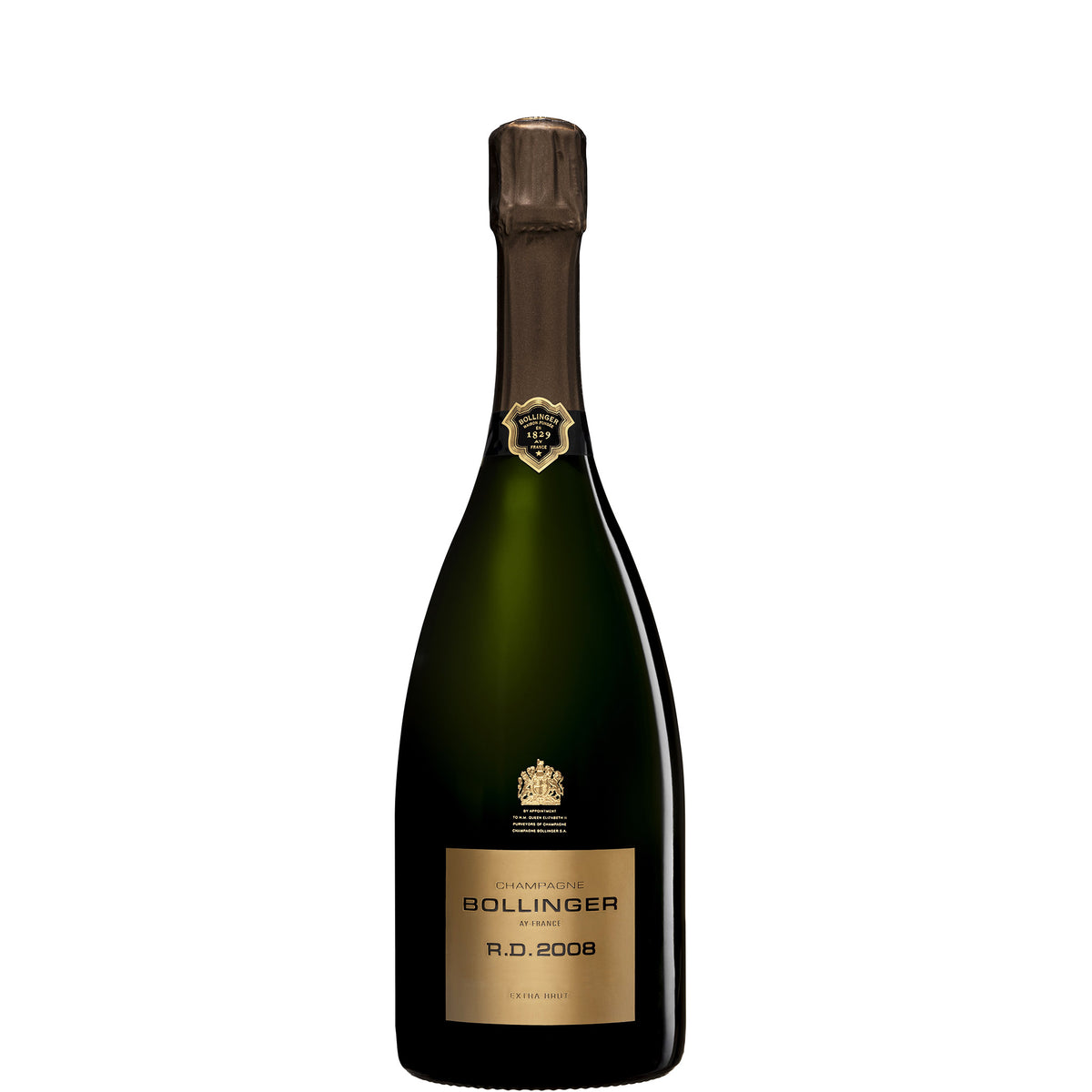
Bollinger RD, 2008 - '2024 Release'
Bollinger RD, 2008 - '2024 Release'
- 75cl
- 12.5%
- White Sparkling
- Pinot Noir, Chardonnay
Couldn't load pickup availability

Optimal drinking window: Now - 2040
Cases of 6 are presented in original wooden cases.
One of our fastest selling wines in 2023 was the first disgorgement of Bollinger’s much anticipated R.D. 2008 – awarded 98+ points by The Wine Advocate’s William Kelley and the accolade "The finest R. D. of the decade". The maison has now released a second, even later disgorgement with the wine having spent a further 11 months resting prior to release.
The 2008 is a blend of 71% Pinot Noir and 29% Chardonnay: 90% of the fruit is from Grand Cru vineyards (and the remainder from Premier Crus) - mainly Ay and Verzenay for the Pinot Noir, and Le Mesnil-sur-Oger and Cramant for the Chardonnay. This latest disgorgement took place at the end of October 2023, a full year after the first release, adding even more complexity from a staggering 15 years on its lees. Only 3g dosage was added, ensuring this is firmly extra dry. Truly a Champagne for the ages, this is an exceptional expression of the top cuvée from one of the finest maisons in a vintage that will stand alongside the greatest of all time.
This RD arrives already in a developed, secondary phase thanks to its long lees ageing, so the primary apple and citrus fruit has already folded into something nuttier and more savoury. Expect it to hold at this plateau for a good decade, the toasted and honeyed notes deepening gradually rather than fading. Given Bollinger's track record with 2008, a strong, long-lived vintage, there's little urgency here; this is a bottle that rewards those who leave it be until 2040 or beyond before it shows any sign of decline.
What the critics say:
"When I was tasting Bollinger's brilliant Grande Année in this vintage, I was trying to imagine how good the 2008 Extra-Brut R. D. would be, as the style of the vintage seems almost perfectly adapted to this cuvée. Four years later, we have the answer, and the wine is brilliant. Disgorged in 2022, it's more reserved out of the gates than the dramatic Grande Année was on release, unwinding in the glass with notes of crisp orchard fruit, orange peel, freshly baked bread, subtle hints of fino sherry, wet stones and macadamia nut. On the palate, it's medium to full-bodied, with a deep core of fruit that's animated by racy acids and a refined pinpoint mousse, concluding with a bone-dry finish. Extremely harmonious and full of youthful energy, it's the finest R. D. of the decade and one that will richly reward a bit of additional age on cork. In style, the most obvious comparison is with the 1996, but the 2008 is more integrated and harmonious on release."
Tasting Notes
AppearanceDeep gold with a fine, persistent mousse.
NoseToasted brioche and roasted hazelnut sit over baked apple and quince, with a smoky, almost savoury edge developing in the glass.
PalateFull and textured for Champagne, with honeyed orchard fruit balanced by a firm seam of saline acidity and a gentle grip of tannin from the Pinot Noir.
FinishLong, dry, and faintly smoky, with the acidity doing all the final work.
Overall impressionA Champagne built on patience, tasting of both its youth and its age at once.
Food Pairings
In Aÿ and around Reims, a wine like this would be poured with roast chicken basted in its own juices, or with the region's quiet speciality, poached turbot in a cream and Champagne sauce. Older RD vintages are classic partners for mature Comté or a well-aged Chaource, the cheese's richness meeting the wine's own developed, nutty character head on. Locals would just as happily serve it with a simple roast partridge in autumn, letting the wine's savoury depth do the heavy lifting.
We think this wine would go well with
Serve at 10-12°C, a touch warmer than you would a young non-vintage Champagne, to let the toasted, nutty notes show properly. No need to decant in the traditional sense, but pouring into the glass fifteen minutes before drinking and letting it open in a good tulip-shaped glass makes a real difference. Avoid flutes, which trap the aromas rather than releasing them.
The grapes for Bollinger's blends come predominantly from Grand Cru and Premier Cru vineyards around Aÿ, Verzenay, and Bouzy, planted on the chalky subsoil that gives Champagne its drainage and its mineral lift. Pinot Noir dominates here, grown on east and southeast-facing slopes that catch the morning sun and ripen slowly in the region's marginal, cool climate. That chalk is the quiet engine of the wine's precision, drawing moisture evenly and reflecting light back into the canopy.
Champagne AOC permits only Chardonnay, Pinot Noir, and Pinot Meunier, grown within a strictly delimited area north of Paris, and demands a minimum of fifteen months on lees for non-vintage wines. Vintage Champagne, as this is, must come entirely from a single declared year and spend at least three years ageing before release, though houses like Bollinger routinely exceed that minimum by a wide margin. RD takes this further still, with no fixed minimum but an understood expectation of a decade or more on lees before disgorgement, a practice almost unique to Bollinger among the grandes marques.
The 2008 vintage in Champagne arrived as something of a surprise package after a growing season that kept producers guessing until the very end. A cool, wet summer had many fearing the worst, but September delivered the kind of weather that makes vignerons believe in providence again. The late-season sunshine and dry conditions allowed for a patient harvest that rewarded those who waited, producing grapes with the sort of pristine acidity that Champagne practically demands.
What emerged from this roller-coaster year was a vintage of remarkable freshness and tension, particularly from Chardonnay, which seemed to thrive in the challenging conditions. The wines show a mineral backbone that we find absolutely thrilling, with a purity of fruit that makes them feel almost weightless on the palate. These bottles are drinking superbly now, having developed the toasty, honeyed depth that comes with proper bottle age, yet they retain enough verve to cellar happily until 2035. We think 2008 represents one of those vintages that reminds you why Champagne can be so utterly compelling when everything clicks.
FAQs
What does Bollinger RD 2008 taste like?
Toasted brioche, baked apple, and roasted hazelnut over a taut, saline backbone, finishing long and faintly smoky.
When should I drink this wine?
It's drinking beautifully now and will hold its plateau until 2040, so there's no rush.
What does RD mean?
Récemment Dégorgé, meaning recently disgorged. The wine ages far longer than usual on its lees before being finished and released.
What food should I pair it with?
Roast chicken, poached turbot in a cream sauce, or a well-aged Comté or Chaource.
Should I decant it?
No formal decanting needed, but pour it and let it sit for fifteen minutes in a tulip glass before drinking.
Is this wine worth cellaring further?
Yes. It has the structure and acidity to improve for another decade or more if you have the patience.
Explore related wines


What are you looking for tonight? Tell me the occasion, a grape, a region — or just try a suggestion below.
Your recommendations will appear here.
-
-
Speak to one of our Wine Gurus
Speak to a Wine GuruWith years of experience, our team can help you with all your wine buying and selling needs