

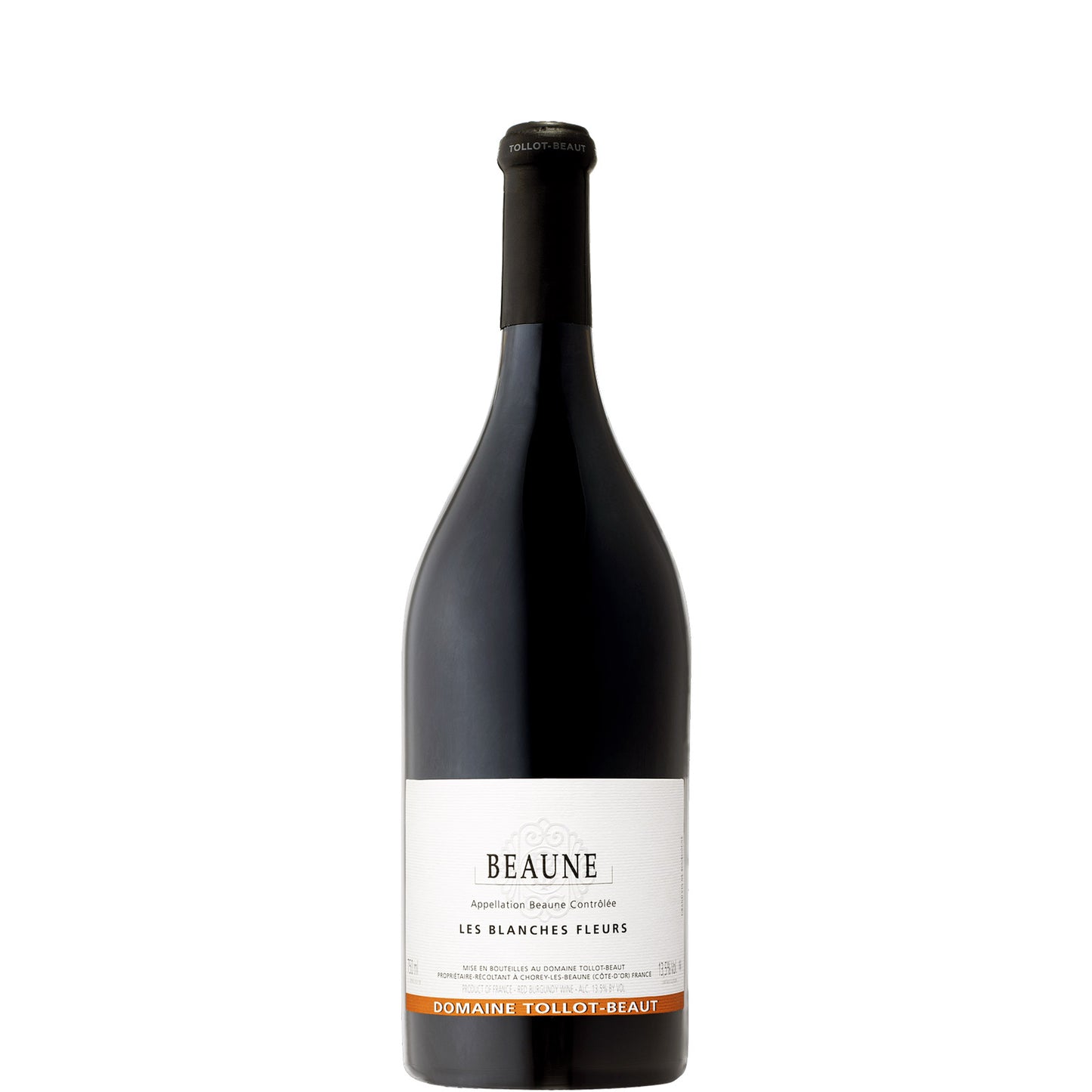
Beaune 'Les Blanches Fleurs', Domaine Tollot-Beaut, 2019
Beaune 'Les Blanches Fleurs', Domaine Tollot-Beaut, 2019
- 75cl
- 13%
- Red Still
- Pinot Noir
Couldn't load pickup availability

Optimal drinking window: Now - 2034
Lying just to the north of the Beaune Premier Cru of Clos Du Roi, Domaine Tollot-Beaut's Les Blanches Fleurs is one of the classiest Beaune wines you're liable to find, despite not being a Premier Cru vineyard.
It's generous, well fruited and with the typical Tollot-Beaut touch that just exudes class.
The 2019 vintage has given this wine a warmth and generosity that makes it genuinely appealing right now — the fruit is primary and bright, the tannins are smooth, and there is no need to wait. Over the next two to four years, the red fruit will begin to deepen and knit with the earthy, savoury notes, adding complexity without losing the wine's essential charm. By around 2028-2030, it should be at its most complete, offering that classic Burgundian balance between fruit and secondary character. Beyond 2032, the fruit will begin to recede and the wine will take on a more dried-fruit, autumnal quality that will appeal to some and not others. This is not a wine to sit on indefinitely — its pleasure lies in drinking it while the vitality is still very much present.
Tasting Notes
AppearanceBright, mid-ruby with a clear, clean rim and good depth for a village wine.
NoseFresh red cherry and strawberry lifted by a faint floral quality — dried rose petal, perhaps a touch of violet. Underneath, there is a gentle earthiness, like damp autumn leaves and a whisper of spice from oak that has been well integrated rather than imposed.
PalateThe 2019 ripeness shows through immediately, giving the wine a generosity and roundness that makes it immediately engaging. The fruit is ripe but not overblown — cranberry and Morello cherry with a savoury undercurrent of forest floor and a fine-grained tannic structure that gives it real shape. Acidity is bright enough to keep everything lifted and alive.
FinishClean and persistent, with the fruit fading gradually into a dry, mineral-tinged close.
Overall impressionA village Beaune that genuinely earns its price, sitting comfortably between easy-drinking and cellar-worthy.
Food Pairings
In Beaune, this kind of wine would appear on a Sunday table alongside poulet de Bresse roasted with tarragon and a little cream, or a plate of jambon persillé from the charcutier in the market. The locals would think nothing of opening it with a simple oeufs en meurette, the red wine sauce echoing what is in the glass. A platter of Époisses or Comté at the right temperature would also do it great justice. This is food-friendly Burgundy at its most honest — nothing too heavy, nothing too delicate.
We think this wine would go well with
Serve at around 15-16°C — cool enough to keep the wine's freshness intact but warm enough to let the fruit open up. A brief decant of 20-30 minutes will help, particularly if the bottle is young and the wine feels a little closed on first pour. A standard Burgundy glass with a wide bowl works perfectly here, giving the more delicate aromas enough room to gather without disappearing into thin air.
Les Blanches Fleurs sits just north of the Premier Cru Clos du Roi on the mid-slope of the Beaune hill, where the soils are a mix of limestone and marl over harder rock. This position gives the vineyard good drainage and enough depth to produce wines with structure as well as generosity. The aspect catches afternoon sun well, which in a warm vintage like 2019 means ripeness comes naturally without sacrificing freshness. It is classified as village Beaune rather than Premier Cru, but the geology here is not far off its more decorated neighbours.
Beaune is both the beating heart of the Côte de Beaune and one of Burgundy's most underrated appellations for red wine. It has more Premier Cru vineyards than anywhere else in Burgundy — over 40 of them — yet the name rarely commands the prices of Gevrey or Vosne. That relative modesty is the buyer's friend. The wines tend to be more approachable in youth than their Côte de Nuits counterparts, with a characteristic mix of red fruit and earthy warmth that is distinctly Beaunois. Village-level wines like Les Blanches Fleurs sit outside the Premier Cru hierarchy but can punch well above their classification in the right hands.
The 2019 vintage in Burgundy delivered exactly what vignerons needed after a string of challenging years: a textbook growing season that let the grapes ripen slowly and evenly. Spring arrived gently, summer stayed warm without punishing heat spikes, and crucially, September brought those cool nights that preserve acidity whilst allowing full phenolic ripeness. We find ourselves talking about 2019 as one of those vintages where nature simply cooperated, giving winemakers healthy fruit with natural balance rather than forcing them to correct for extremes in the cellar.
What emerged are Burgundies with remarkable freshness married to genuine depth—the Pinot Noirs show that silky texture and bright red fruit character that makes great Burgundy so compelling, whilst the Chardonnays have both the mineral backbone and subtle richness that age beautifully. The quality runs impressively deep across all appellations, from village wines that drink like premier crus to grand crus that remind you why Burgundy commands such devotion. These wines are drinking beautifully now if you fancy them young and vibrant, though we suspect the better bottles will reward patience well into the 2030s.
FAQs
What does Beaune Les Blanches Fleurs taste like?
Think ripe red cherry and strawberry, a touch of dried rose petal, and an earthy, forest-floor quality underneath. The 2019 vintage brings real generosity and roundness, with enough structure to give the wine proper shape. It is approachable and food-friendly, but there is more going on here than a simple quaffer.
Is this a Premier Cru wine?
No — Les Blanches Fleurs is classified as village Beaune rather than Premier Cru, which is part of what makes it such good value. It sits just north of the Premier Cru Clos du Roi on the same hillside, with similar soils, and in Tollot-Beaut's hands it routinely outperforms its classification.
When is the best time to drink this wine?
It is drinking well now and will continue to do so until around 2035. The 2019 vintage is generous and approachable in its youth, so there is no need to wait — though a couple more years in the cellar will bring additional complexity.
What food works well with this wine?
Classic Burgundian fare is the obvious answer — roast chicken, jambon persillé, oeufs en meurette. But it is also versatile enough for a good plate of charcuterie, a mushroom risotto, or a simple grilled salmon fillet. The key is avoiding anything too rich or heavily sauced, which would overwhelm the wine's natural elegance.
How should I serve it?
Serve at around 15-16°C — slightly cooler than room temperature. A short decant of 20-30 minutes will open it up nicely. Use a standard Burgundy glass with a wide bowl to give the aromas room to develop.
Is Tollot-Beaut a reliable producer?
Very much so. Tollot-Beaut is one of the most consistent and honest domaines in Beaune, farming the same family vineyards for generations. They are not the flashiest name in Burgundy, which is precisely why their wines represent such good value — the quality is in the glass, not the hype around the label.

Explore related wines


What are you looking for tonight? Tell me the occasion, a grape, a region — or just try a suggestion below.
Your recommendations will appear here.
-
-
Speak to one of our Wine Gurus
Speak to a Wine GuruWith years of experience, our team can help you with all your wine buying and selling needs