

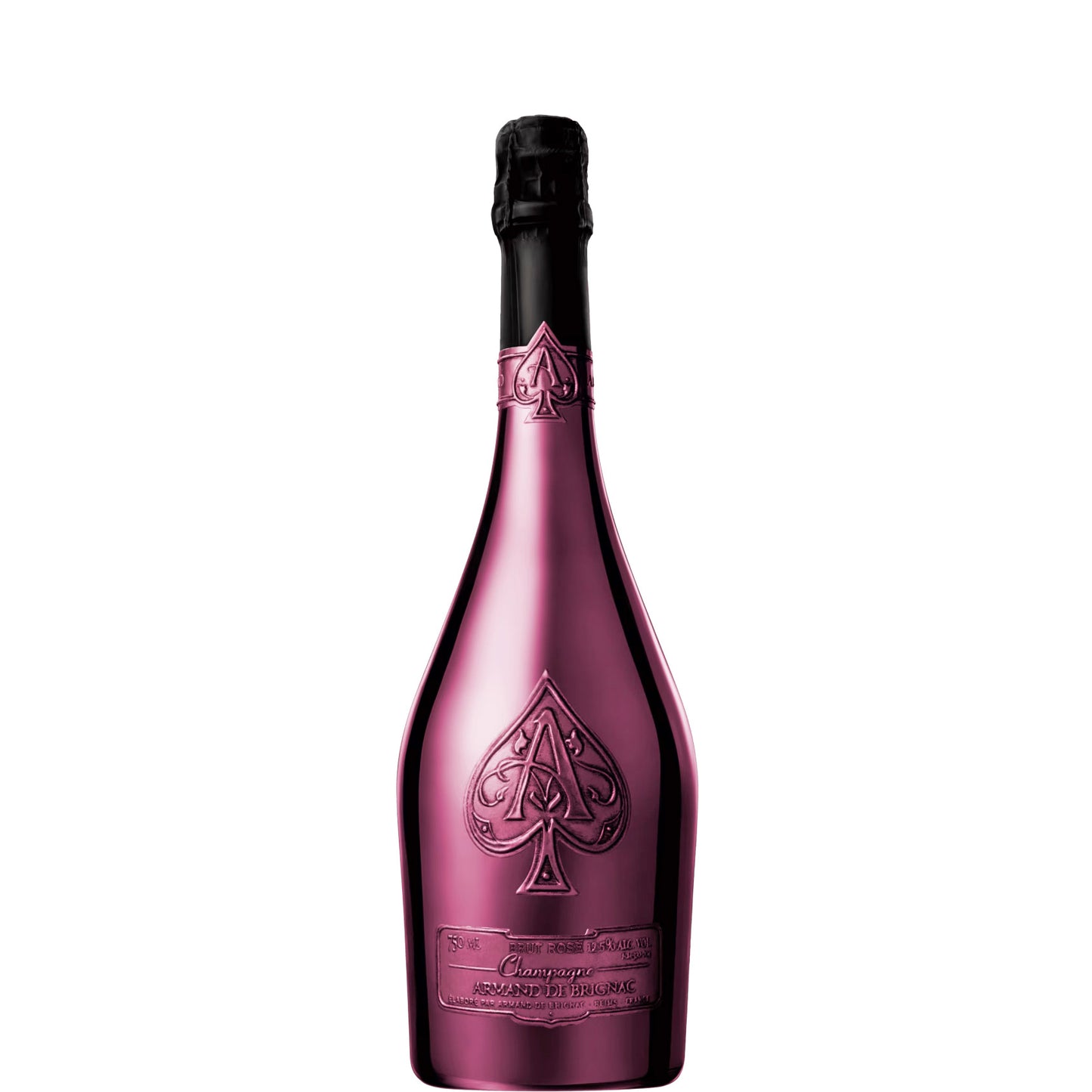
Armand de Brignac 'Ace of Spades' Brut Rosé, MV
Armand de Brignac 'Ace of Spades' Brut Rosé, MV
- 75cl
- 12.5%
- Rosé Sparkling
- Pinot Noir, Pinot Meunier, Chardonnay
Couldn't load pickup availability

Optimal drinking window: 2026 - 2030
Please note that this champagne is offered without gift box.
Armand de Brignac, often referred to as the "Ace of Spades" due to its iconic bottle design, is a prestigious Champagne brand produced by the Cattier family, since 1763, in the Montagne de Reims region. Their Champagnes are crafted from a blend of three vintages, combining freshness, depth, and complexity.
Featuring a high percentage (55%) of Pinot Noir, the Brut Rosé has a balanced, creamy texture with notes of red berries, citrus, and hints of blackcurrant, complemented by soft tannins and a crisp acidity. Enjoy it as an apéritif or pair with truffled veal, duck confit, or seafood, and wild salmon.
This is a multi-vintage blend designed to be drunk, not cellared — its appeal lies in the freshness and fruit of the younger component vintages. Right now the red fruit is vivid and the creamy texture is at its most generous. Over the next two to three years it will hold well, but we would not expect any meaningful increase in complexity with age. By 2030 the primary character may start to fade, and there is little secondary development to compensate. Open it, enjoy it, and do not be tempted to tuck it away out of sentiment for the bottle.
Tasting Notes
AppearancePale salmon-copper with fine, persistent streams of tiny bubbles rising through the glass.
NoseFresh strawberry and raspberry upfront, with a deeper suggestion of black cherry and a light pastry note from extended lees ageing. There is something almost confectionery about it — not in a sweet way, but in the way a good patisserie smells before you walk through the door.
PalateCreamy and round on entry, with the Pinot Noir making its presence felt in the weight and the red fruit character that runs through the mid-palate. Crisp acidity keeps it from feeling heavy, and there is a subtle phenolic grip — almost a whisper of tannin — that sets it apart from lighter rosé styles.
FinishClean, moderately long, with a citrus brightness at the very end that lifts everything and sends you straight back for another sip.
Overall impressionGlamorous, yes — but there is genuine winemaking craft underneath the gold lacquer.
Food Pairings
In Champagne, the local instinct is to drink rosé with charcuterie and the region's own andouillette, or alongside richer fish preparations. Truite au bleu — river trout poached simply in court bouillon — is a classic pairing that lets the wine's acidity shine. The Pinot Noir-dominant blend makes it more at home with meat than many rosé Champagnes: think rabbit in mustard sauce or a simple roast duck. Locally produced Chaource cheese, soft and slightly tangy, is another natural match that does not demand anything fussy from the wine.
We think this wine would go well with
Serve well chilled, between 8 and 10 degrees Celsius — cold enough to keep the bubbles lively, but not so cold that the fruit retreats. No need to decant; simply pour into a tulip-shaped or white wine glass rather than a flute, which opens up the aromas considerably more than the classic narrow option. Give it a minute or two in the glass before drinking if you have poured straight from the fridge.
The Montagne de Reims sits between Reims and Épernay, its slopes facing in multiple directions and planted predominantly with Pinot Noir — a grape that thrives on the chalk and clay subsoils here, gaining structure from the cool climate and depth from the limestone-rich ground. The chalk acts as both a natural reservoir for moisture and a source of the mineral tension that gives great Champagne its backbone. These are not the most celebrated individual crus in the region, but the family's long tenure gives them a nuanced understanding of how the land behaves across vintages.
Champagne is the most tightly regulated sparkling wine appellation in the world, covering a defined zone in northeast France and governed by strict rules on grape varieties, yields, pressing, and minimum ageing on lees. Only Chardonnay, Pinot Noir, and Pinot Meunier are permitted in the blend. Non-vintage Champagne must age for at least 15 months on lees; prestige cuvées typically far exceed this. The appellation's reputation is built as much on the art of blending across vintages as on any single year's harvest — which is precisely what makes a wine like this one possible.
FAQs
What does the Armand de Brignac Brut Rosé taste like?
Creamy and generous, with fresh strawberry and black cherry fruit, a subtle pastry note from lees ageing, and a crisp citrus lift on the finish. The high proportion of Pinot Noir gives it more body and structure than most rosé Champagnes at this price point.
When should I drink this?
Now — this is a wine built for current pleasure, not the cellar. It will hold comfortably until around 2030, but there is nothing to gain from waiting. Open it for a celebration and enjoy it at its freshest.
What food works well with it?
More versatile than you might expect from a rosé Champagne. It works beautifully as an apéritif but genuinely earns its place at the table with duck confit, wild salmon, or truffled veal. The Pinot Noir backbone means it can handle richer, more flavoursome dishes than a lighter blanc de blancs style.
Is it worth the price?
That depends what you are paying for. As a Champagne, it is well made and genuinely enjoyable. As an object — the iconic gold bottle, the cultural cachet — it delivers something that no straightforward wine assessment can fully account for. If the occasion calls for it, we think it earns its place.
How should I serve it?
Chill it to between 8 and 10 degrees Celsius and serve in a tulip-shaped glass or a wide white wine glass rather than a traditional flute — you will get far more from the aromas. No decanting needed. Give it a minute after pouring if it has come straight from the fridge.
Is this the same as the regular Ace of Spades Brut NV?
Similar house style but distinctly different in character. The Brut Rosé is dominated by Pinot Noir, giving it more weight, red fruit depth, and a light phenolic texture that the Blanc de Blancs and standard Brut NV do not have. If you want something richer and more food-friendly, this is the one to reach for.
Explore related wines


What are you looking for tonight? Tell me the occasion, a grape, a region — or just try a suggestion below.
Your recommendations will appear here.
-
-
Speak to one of our Wine Gurus
Speak to a Wine GuruWith years of experience, our team can help you with all your wine buying and selling needs